Vivantio AI Assist

Fewer repeat questions. Better context from the start.

Users expect immediate answers. Repetitive, well-documented requests shouldn't reach an agent. And when a ticket is needed, it should arrive with the context required to act — not the starting point for a round of clarifying questions.

Answers grounded in your own knowledge — not generic web results.

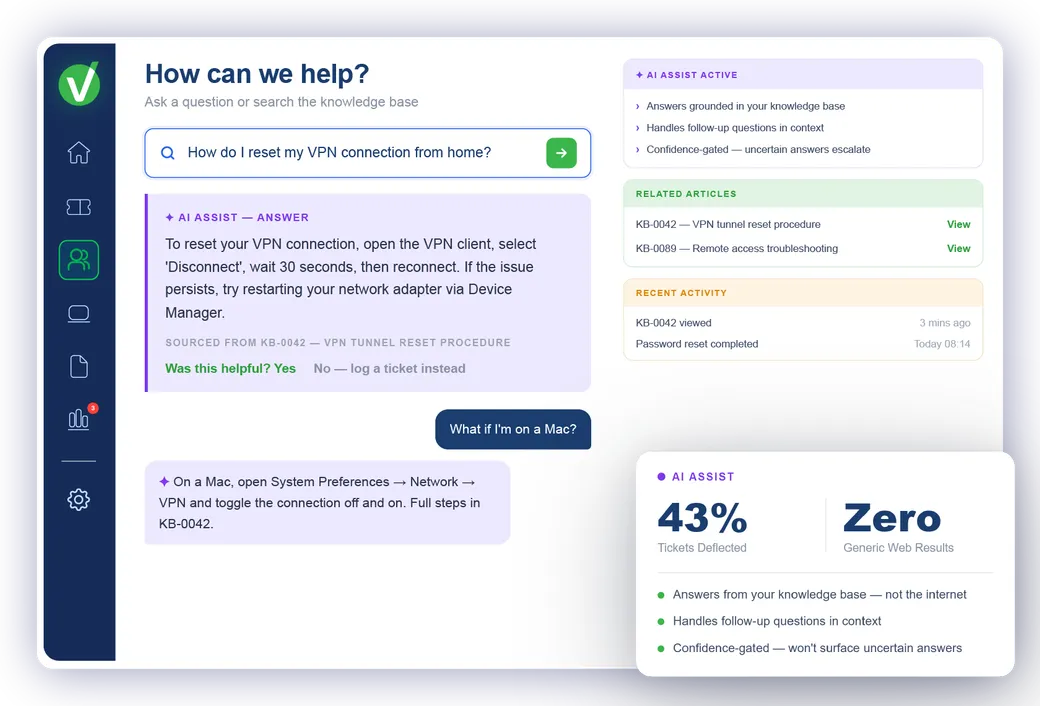
Vivantio AI Assist — answering a user question at the self-service portal

Service teams at leading organizations trust Vivantio

The problem it solves

Your team's time is worth more than answering the same question twice.

Repetitive, well-documented requests sit in the same queue as complex problems and take the same human effort to handle. That's not a staffing problem. It's a tooling problem.

Without AI Assist

User asks a password reset question: agent picks it up, answers it, closes it

Ticket arrives with no context: agent spends the first exchange asking clarifying questions

Resolution time drags because intake captured none of the information agents needed

Repetitive, well-documented requests occupy queue capacity alongside complex work

With Vivantio AI Assist

AI suggests the resolution from the knowledge base: agent reviews and sends in one step

Smart intake captures context before the ticket is assigned: agents start work immediately

Agents resolve in the first response: full context available before they open the ticket

Routine requests handled with AI assistance: agents focused on work that needs them

What AI Assist does

Resolve what should be resolved. Escalate with what matters.

AI Assist works at the point of contact — the self-service portal — where users search for answers or raise new requests.

Knowledge-grounded answers

Answers from your knowledge — not the internet

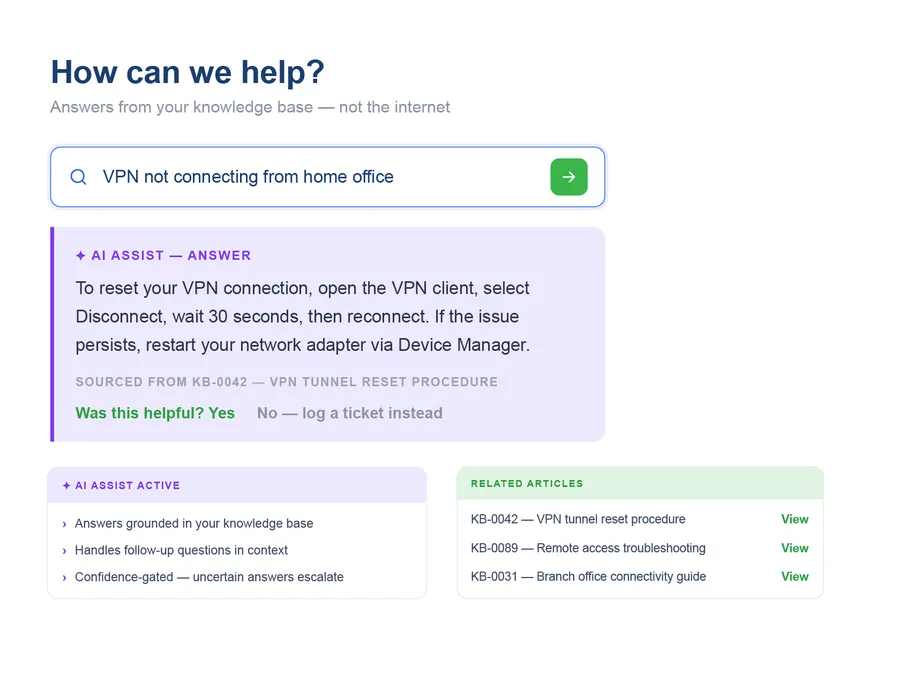
When a user searches or asks a question, AI Assist retrieves and surfaces relevant answers from your organization's knowledge base. Responses are grounded in your documented resolutions, policies and procedures — so they're accurate for your environment, not generic. Users get answers immediately; agents avoid the queue.

  • Answers drawn from your Vivantio knowledge base
  • Handles follow-up questions in context
  • Confidence-gated — won't surface uncertain answers
See how the knowledge base works
AI Assist surfacing a knowledge-base answer in the self-service portal
Guided intake

When a ticket is needed, capture what agents actually need

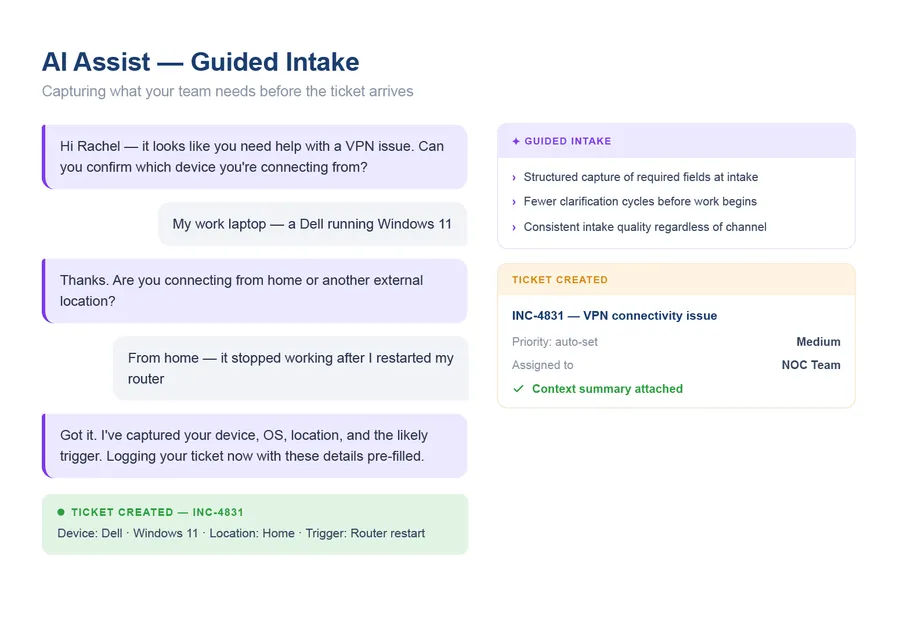
Not every request can be self-resolved — and AI Assist doesn't try to force it. When a ticket is needed, AI guides the user through a structured intake conversation: asking the right questions upfront, gathering the fields agents need, and removing the ambiguity that causes back-and-forth. The ticket arrives complete, not half-formed.

  • Structured capture of required fields at intake
  • Fewer clarification cycles before work can begin
  • Consistent intake quality regardless of how the request is raised
See how self-service works
AI Assist guiding a user through structured ticket intake
Auto-summary & escalation with context

Context travels with the ticket — not behind it

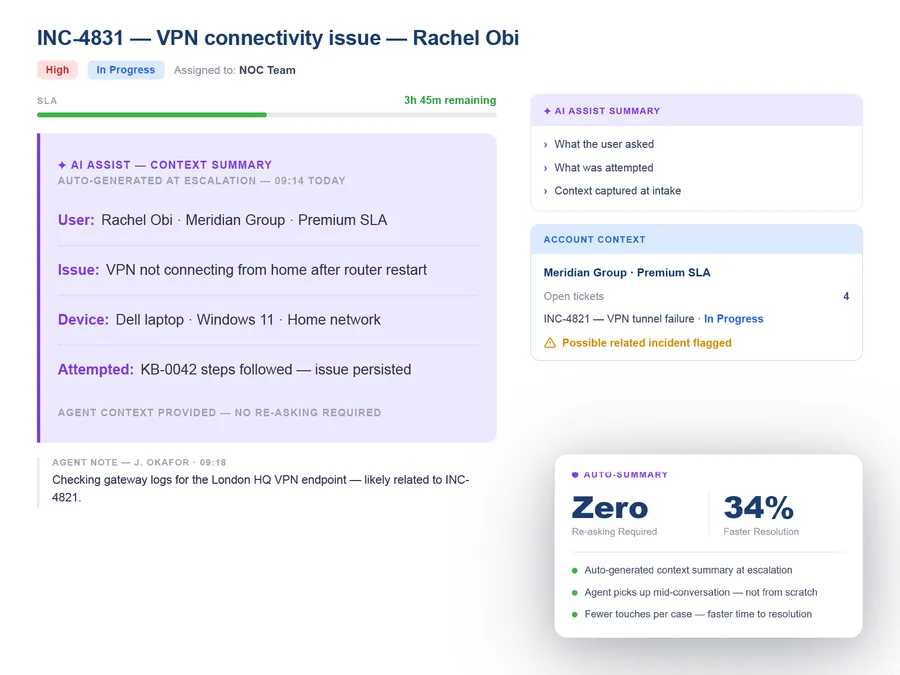
When AI Assist escalates to a human agent, it attaches an auto-generated summary of the interaction: what the user asked, what was attempted, what context was captured at intake. Agents start from a position of understanding — not a blank ticket. No re-asking. No wasted first exchange.

  • Auto-generated context summary attached to every escalated ticket
  • Agent picks up mid-conversation, not from scratch
  • Fewer touches per case — faster time to resolution
Agent view showing AI-generated summary on an escalated ticket
Works alongside

Where AI Assist fits in your platform

AI Assist extends capabilities already in Vivantio — it doesn't replace them.

Recognised by the teams who use us every day
G2 Leader — United Kingdom Service DeskG2 Leader — Enterprise Service DeskG2 Leader — Mid-Market Complaint ManagementG2 Leader — HR Service DeliveryG2 Leader — Mid-Market IT Asset ManagementG2 Leader — Mid-Market ITSMG2 Leader — IT Service Management
Common questions

AI Assist: what teams ask us

What types of questions can Vivantio AI Assist answer?

Vivantio AI Assist answers questions grounded in your organization's own knowledge base — not generic web results. It handles the well-documented, repetitive requests that agents deal with repeatedly: password resets, access requests, software guidance, policy questions. Complex or sensitive requests it cannot confidently resolve are escalated to a human with full context attached.

What happens when AI Assist can't answer a question?

When AI Assist cannot confidently resolve a request, it guides the user through structured intake — capturing the information an agent needs to act. The resulting ticket arrives with an auto-generated summary of the user's context, so agents can start working immediately rather than asking clarifying questions.

How does AI Assist reduce back-and-forth between users and agents?

Most back-and-forth happens because tickets arrive thin on context. AI Assist addresses this at intake: it asks structured questions upfront and attaches an auto-summary to every escalated ticket. Agents get what they need to start working, not a starting point for investigation.

Is AI Assist connected to the Vivantio knowledge base?

Yes. AI Assist draws on the knowledge base already in Vivantio — your articles, policies, and documented resolutions — so answers are grounded in your organization's actual content. The knowledge base gets more useful as it grows, and AI Assist surfaces it at the moment a user needs it.

See it in action

Fewer tickets to handle. Better ones when they arrive.

We'll show you how AI Assist fits into your self-service setup — with a demo built around your actual request types and knowledge.

~30-minute demo No commitment Built around your request types